

How to Create an FAQ From Customer Questions With AI
Customers keep asking the same questions, but the answers are scattered across emails, policy pages, and one person's memory.
Give the AI one approved source: give AI anonymized questions plus one approved source of truth, require [CHECK POLICY] for anything the source does not answer, and verify every answer before it goes on your website.
AI can group and rewrite questions. It should not create your return, warranty, privacy, or shipping policy.
The fastest way to do it
- Collect 10 to 30 repeated questions.
- Remove names, emails, order numbers, addresses, and payment information.
- Paste the approved policy or help text above the questions.
- Ask AI to combine duplicates and mark unsupported answers.
- Have the policy owner review the result before publishing.
Start with a small batch. A short, checked FAQ is more useful than 50 answers nobody has verified.
Copy this prompt
Create a short FAQ from the customer questions below.
Use only the approved policy as the source for answers. Combine questions that mean the same thing. Write clear, plain-English answers.
Put
[CHECK POLICY]wherever the policy does not answer the question. Do not invent shipping times, refund timing, eligibility, fees, warranties, or exceptions.For each FAQ, show which original question numbers it covers.
APPROVED POLICY:
[paste the approved source]
CUSTOMER QUESTIONS:
[paste anonymized questions]
The original-question numbers make it easier to check whether anything disappeared during grouping.
What happened in H5W's real test
H5W tested the workflow in a logged-in Gemini Temporary Chat on October 12, 2026. We used eight fictional customer questions and a short fictional return policy.
Gemini combined the eight questions into six useful FAQ entries. It correctly marked four gaps:
- international shipping;
- exchange availability;
- exact refund-processing time;
- who pays return shipping for a damaged item.
Those answers became [CHECK POLICY] instead of confident guesses.
It did not invent the missing answers. However, it combined “Do you ship internationally?” and “Can I exchange an item?” into one FAQ simply because both answers were missing. Those are different customer tasks and would be clearer as separate entries.
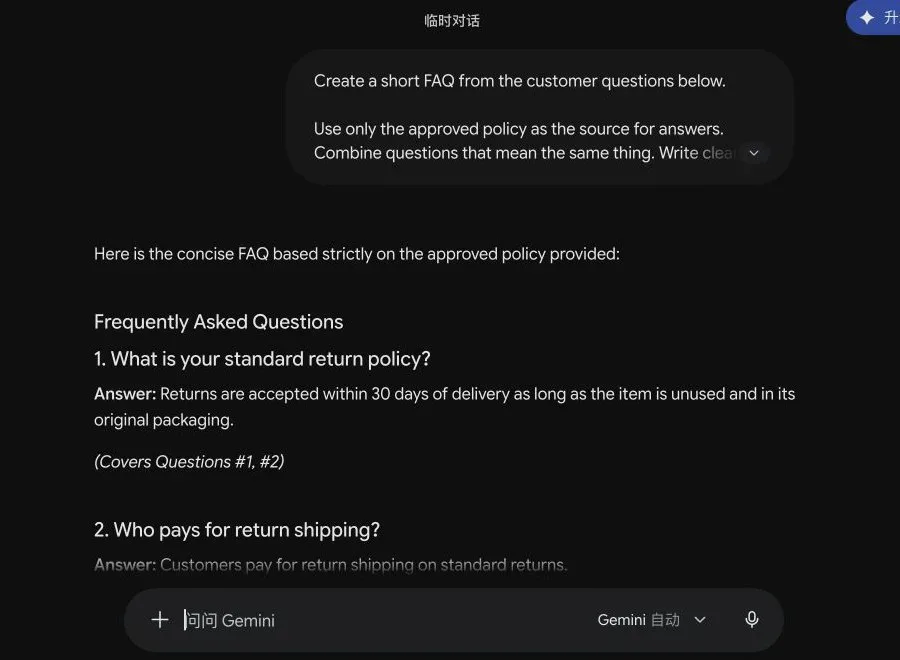
Useful lesson: checking facts is not enough. Also check whether AI grouped questions that belong together from a customer's point of view.
A simple approval check
Before publishing, label each answer:
- Approved: directly supported by a current policy.
- Needs wording: accurate, but unclear or too technical.
- Needs policy: the business has not decided the answer.
- Remove: too rare, too private, or better handled by support.
Do not use “sounds reasonable” as an approval status.
What should not go into the AI tool
Remove:
- customer names and email addresses;
- order, invoice, or tracking numbers;
- home addresses and phone numbers;
- payment or account information;
- full private email threads;
- health, identity, legal, or employee information.
Usually the question itself is enough: “Can I return an unused item after two weeks?”
If you first need to find repeated themes, see How to Analyze Customer Reviews With AI.
Practical tips
- Keep one approved policy document as the source of truth.
- Add the policy date to the prompt.
- Ask for customer language, not internal terms.
- Keep one question per FAQ heading.
- Put the direct answer in the first sentence.
- Link to the full policy when details matter.
- Schedule a review when prices, timelines, or rules change.
- Do not add FAQ schema unless the visible page contains the same reviewed questions and answers.
For replies that still need a personal response, use How to Write a Professional Email With AI.
Privacy tip
H5W used fictional material in Gemini Temporary Chat. Google states that Gemini data handling depends on settings and account type, and warns users not to enter confidential information they would not want reviewed or used to improve services. Temporary Chat reduces history and training exposure, but it is not a reason to paste raw customer records.
The bottom line
AI can turn repeated questions into a clean first draft. The trustworthy part comes from pairing those questions with an approved source and refusing to fill policy gaps. Every published answer should be traceable to something your business has actually decided.
Sources and verification
Information last verified: October 12, 2026.
Hands-on test completed October 12, 2026, in Gemini Temporary Chat using fictional questions and a fictional policy. No customer data was used.
Free printable resource
AI Business Writing Brief Pack
Use the practical version while you work. It is a selectable-text U.S. Letter PDF with no email gate.
Public H5W PDF with selectable text and permanent source links.
Keep going
Choose your next step
Return to Small Business for the full collection, or continue with a closely related guide.