
How to Tell if an AI Training Job Is a Scam
The message says you can train AI from home. The hours are flexible, the pay sounds generous, and the recruiter wants to move the conversation to WhatsApp or Telegram. Then comes a request for ID, bank details, a paid training course, or a deposit to unlock your earnings.
Do not decide from the logo, writing style, or the fact that “AI trainer” sounds like a real job. Treat the offer as unverified until you find the company and exact role independently. Stop if you must pay, deposit crypto, cash a check, buy equipment from the recruiter, or provide sensitive information before a real interview and hiring process.
The five-minute check
- Do not use the message's link. Search for the company yourself and open its official website.
- Find the exact role on the company-controlled careers page. A listing on a job board alone is not enough.
- Compare the recruiter and process. Check the sender's full address, company domain, role title, duties, pay method, and interview steps.
- Look at what they want from you now. Money, crypto, gift cards, bank details, an ID copy, a password, or a one-time code means stop or verify through a separate official channel.
- Choose one result: continue cautiously, pause and verify, or stop and report.
The most important rule is short: a job pays you. You do not pay the job.
Quick decision table
| What happens | What it means | What to do |
|---|---|---|
| You get an unexpected text offering easy online “AI tasks” | The contact and job are unverified | Do not click; find the company independently |
| You must deposit money or crypto to unlock tasks or withdraw earnings | This matches the task-scam pattern described by the FTC and FBI | Stop and do not pay |
| You receive a check and must buy equipment or return the extra money | The check may be fake even if the bank initially shows funds | Do not deposit or send money |
| The recruiter uses Gmail, Outlook, WhatsApp, or Telegram instead of a company account | It may be impersonation; it is not proof by itself | Pause and verify through the official company site |
| The role appears on the real careers page and the process includes a normal interview | The opportunity may be real, but it is not guaranteed | Continue cautiously and keep checking |
| They ask for Social Security, tax, ID, or bank details before interviewing or hiring you | Your identity or money may be the real target | Stop and contact the company independently |
One odd detail does not always prove fraud. A request for money or a deposit is different: do not continue.
Real AI training work is not the same as an “AI task” app
Legitimate AI-related contract work can include rating answers, writing examples, checking facts, labeling data, translating text, or evaluating code. The work may be irregular, project-based, and subject to screening. A real opportunity can still pay less than expected or run out of assignments.
A task scam uses similar words for a different purpose. It may ask you to rate products, click buttons, “optimize” listings, or complete simple batches inside an app. A balance appears to grow, but you must add your own money before the next batch or before withdrawing. The FTC says those displayed earnings are fake. The FBI likewise warns about work-from-home schemes that require cryptocurrency payments to unlock work.
Do not let the word “AI” make an old scam look new.
Verify the company without using the recruiter's route
Type the company name into your browser. Do not copy the address from the message. Open the official site and check:
- Does the exact job appear on the company's careers page?
- Does the application button stay on the official domain or go to a hiring platform the company names?
- Does the company explain who is eligible, what the work involves, and how selection happens?
- Does the recruiter's email domain match the company domain exactly?
- Can you reach the company through a phone number, support form, or careers contact you found yourself?
Look closely at the domain. A copied logo and an HTTPS padlock do not prove ownership. The FBI warns that fake recruiters may use look-alike websites and copied job listings. company-careers.example and company.example are different addresses even when the pages look identical.
If the role appears only in the recruiter's message, pause. A legitimate company may use outside recruiters, but you should still be able to confirm the recruiter or opening through a company-controlled route.
Check the job, not just the company name
Scammers can impersonate a real business or a real employee. Confirm the exact role rather than stopping when the company exists.
Ask for these details in writing:
- the exact job title and main duties;
- whether the work is employment or independent contracting;
- the pay rate and whether it is hourly, per task, or per project;
- when and how payment happens;
- the expected hours or project availability;
- the interview or assessment steps;
- the country or state eligibility rules;
- who handles contracts, tax forms, and identity verification.
Vague answers are a reason to pause. So is a recruiter who talks constantly about earnings but cannot explain the work.
Use this message to verify the invitation
Do not reply inside the suspicious thread. Send this only through an email address or contact form you found on the company's official website.
I received an invitation for the [EXACT ROLE TITLE] from [RECRUITER NAME AND EMAIL]. Before I share personal information or complete an assessment, can you confirm whether this person is authorized to recruit for your company and whether the role is currently open? The invitation was received on [DATE] through [EMAIL / TEXT / LINKEDIN / OTHER]. I have not included sensitive documents in this message.
Replace [EXACT ROLE TITLE], [RECRUITER NAME AND EMAIL], [DATE], and the contact method. Do not attach your ID, tax form, bank details, or the suspicious file.
Protect your identity during hiring
A real employer may eventually need tax, identity, and payment information. Timing and route matter.
Before an interview and confirmed offer, do not send:
- Social Security or tax-identification numbers;
- a passport, driver's license, or selfie holding an ID;
- bank-account or card details;
- job-board passwords or one-time codes;
- copies of tax forms;
- payment for training, software, equipment, background checks, or access to tasks.
After a confirmed offer, check that onboarding happens through a company-controlled or clearly named payroll/HR service. When uncertain, call a number found on the official website. Do not use the number supplied by the recruiter you are trying to verify.
What H5W tested
H5W applied the checklist to three fictional invitations on October 25, 2026. All names and domains were invented, and every link used the reserved .example ending.
| Fictional invitation | Checklist result | Why |
|---|---|---|
| An unexpected WhatsApp offer to rate AI answers, followed by a crypto deposit to unlock the next batch | Stop and report | The reader must pay to continue or withdraw supposed earnings |
| An email from a personal account offering data-labeling work, with no fee but no listing on the company's site | Pause and verify | It may be impersonation; the company and recruiter have not been confirmed |
| A role found independently on a fictional company careers page, followed by a domain-matching email, a scheduled interview, written duties, and no request for money or early ID | Continue cautiously | The process is consistent, but no checklist can guarantee that a job is genuine |
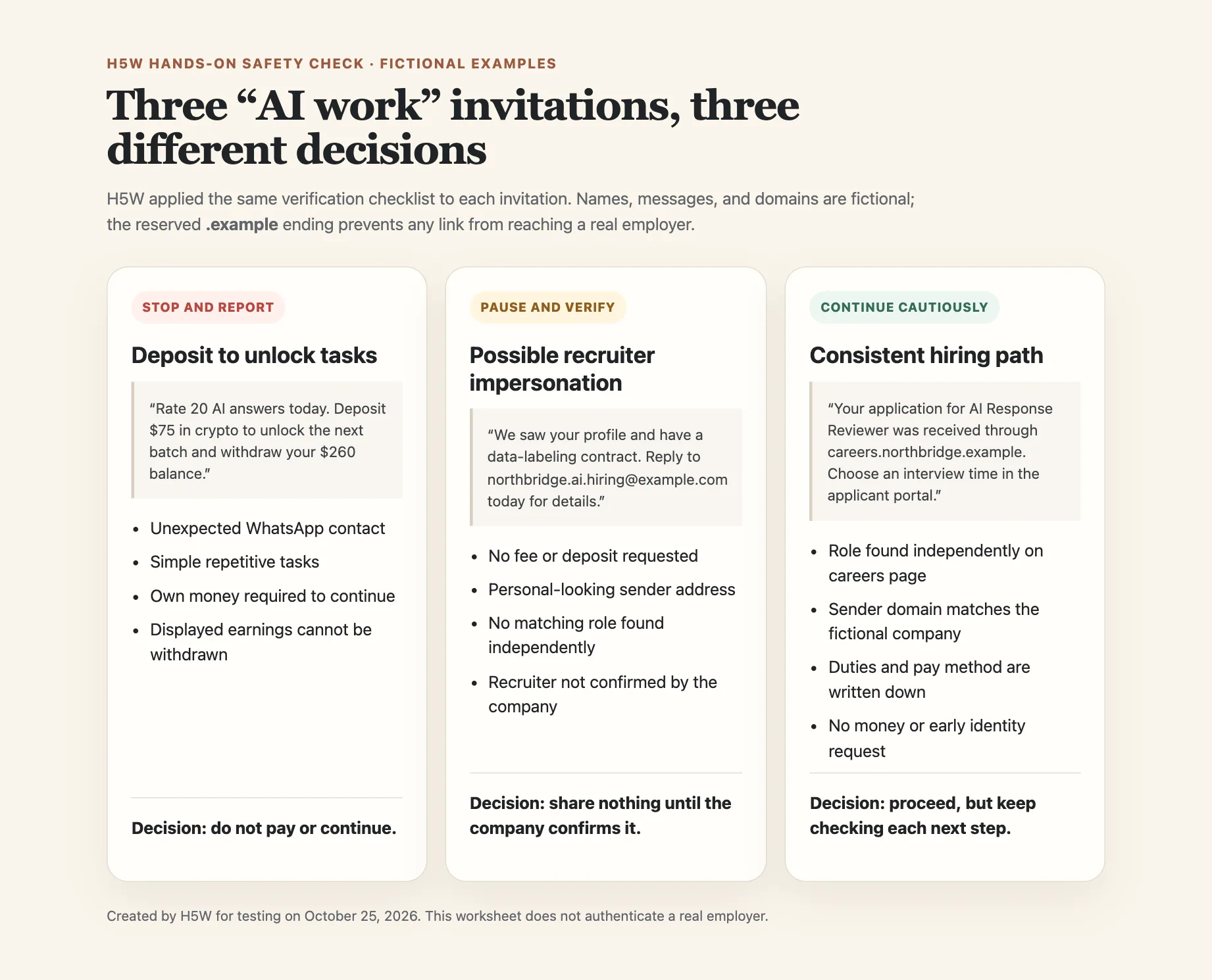
.example domains, not a real employer or applicant.The middle case matters. “Not enough evidence” is not the same as “definitely a scam.” The safe response is to stop sharing information until the company confirms the invitation.
If you already sent money or personal information
Act before trying to prove whether AI was involved.
- You sent money: contact the bank, card issuer, payment app, wire service, or cryptocurrency exchange immediately and ask whether the transaction can be stopped or reversed.
- You deposited a check: contact your bank's fraud department. Do not spend the funds or send any portion elsewhere.
- You shared a password or code: change the password through the real service, sign out unfamiliar sessions, and enable multi-factor authentication.
- You shared an ID, Social Security number, or bank information: use IdentityTheft.gov to create a recovery plan and contact the relevant financial institutions.
- You installed software or opened a file: disconnect from the recruiter, run current security checks, and contact workplace IT if the device belongs to an employer.
Report the job or task scam to ReportFraud.ftc.gov and the FBI's Internet Crime Complaint Center. Also report the listing to the job board and tell the real company if it was impersonated.
Keep the verified opportunity in one place
Once the company and opening pass the independent check, add the official careers-page URL—not the recruiter's shortened link—to your job application tracker.
If the invitation arrived by email, use the same sender, request, link, and independent-route checks in H5W's guide to spotting an AI phishing email.
Sources and verification
Information last verified: October 25, 2026.
- FTC: Job scammers are looking to hire you
- FTC: Task scams create the illusion of making money
- FTC: Job Scams
- FBI IC3: Scammers Defraud Individuals via Work-From-Home Scams
- FBI IC3: Cyber Criminals Use Fake Job Listings To Target Applicants' Personally Identifiable Information
Hands-on test completed October 25, 2026, using three fictional invitations and reserved .example domains. H5W checked whether the process led to distinct stop, pause and verify, and continue cautiously outcomes without claiming that a checklist can authenticate an employer.
Keep going
Choose your next step
Return to Jobs for the full collection, or continue with a closely related guide.