
How to Write a Job Description With AI
You know what the new hire needs to do, but your notes are scattered across an old posting, a manager's email, and a list of “nice to have” skills. AI can organize those facts. It should not decide who is qualified or invent employment terms.
Write down the real essential tasks, schedule, location, reporting line, pay information, and minimum skills first. Ask AI to draft only from those facts, separate required from preferred qualifications, and mark every missing field before anyone posts the job.
Gather the facts before opening AI
Use this short checklist:
- Why does the role exist?
- What does the person actually do in a normal week?
- Which duties are essential, and which are occasional?
- Who does the role report to?
- Is the work on-site, remote, or hybrid?
- What schedule is genuinely required?
- What pay range, benefits, and location disclosures are required where you hire?
- Which skills are truly necessary on day one?
- Which skills can be learned after hiring?
If a manager cannot answer these questions, AI will make the uncertainty look polished rather than solve it.
Copy this prompt
Draft a plain-English job description using only the verified facts below.

Business: [BUSINESS AND LOCATION]
Role title: [ROLE TITLE]
Why the role exists: [ROLE PURPOSE]
Essential tasks: [ACTUAL ESSENTIAL TASKS]
Occasional tasks: [OCCASIONAL TASKS OR NONE]
Reports to: [ROLE OR PERSON]
Schedule and work location: [HOURS, DAYS, ON-SITE / REMOTE / HYBRID]
Pay range and benefits: [VERIFIED DETAILS OR NOT DECIDED]
Required qualifications: [TRULY REQUIRED SKILLS]
Preferred qualifications: [USEFUL BUT NOT REQUIRED SKILLS]

Return:
1. A short job summary.
2. Essential responsibilities, beginning with ordinary action verbs.
3. Verified schedule and location.
4. Qualifications split into required and preferred.
5. Pay and benefits using only the information provided.
6. Accessibility and equal-opportunity review notes for a human reviewer.
7. A section called "Facts the employer must add before posting."

Do not invent salary, benefits, credentials, years of experience, physical requirements, legal statements, or company claims. Do not infer personality, age, gender, health, family status, or other protected information. Label any missing fact [NEEDS EMPLOYER INPUT].
Replace these fields
[BUSINESS AND LOCATION]: use the real hiring entity and job location.[ROLE TITLE]: choose the title people would recognize, not an internal nickname.[ROLE PURPOSE]: one sentence explaining why the work matters.[ACTUAL ESSENTIAL TASKS]: duties the employee must be able to perform.[OCCASIONAL TASKS OR NONE]: tasks that are real but not the core job.[ROLE OR PERSON]: the reporting relationship.[HOURS, DAYS, ON-SITE / REMOTE / HYBRID]: the schedule applicants need to assess.[VERIFIED DETAILS OR NOT DECIDED]: do not ask AI to guess a market rate.[TRULY REQUIRED SKILLS]and[USEFUL BUT NOT REQUIRED SKILLS]: keep the bar honest.
What happened in H5W's test
H5W tested the prompt in Gemini on October 17, 2026, using a fictional part-time counter and order assistant at a Portland bakery. We supplied six real duties for the fictional role and explicitly said that pay, benefits, start date, and prior bakery experience had not been decided.
Gemini produced a readable summary and essential-responsibility list without adding a degree, years of experience, or a physical lifting requirement. It kept the 20–25-hour schedule and some early-morning and weekend work. It also put the missing pay range, benefits, start date, experience decision, and equal-opportunity language on the employer's review list.
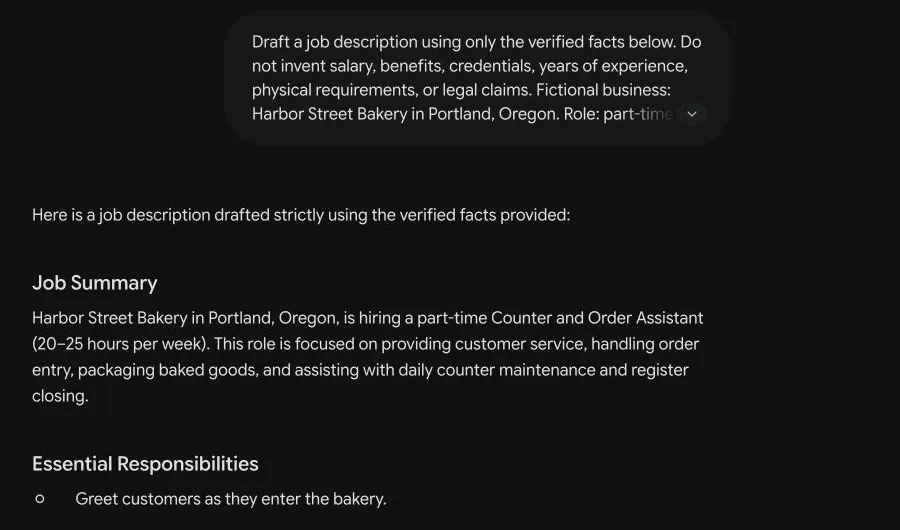
The draft still needed a human review. Gemini used a broad phrase about being able to perform the responsibilities, which is harmless only when the responsibilities themselves are accurate. The employer must also confirm local pay-transparency and posting requirements before publishing.
Edit the draft like an applicant will read it
Put the actual work near the top
Applicants should not have to pass through three paragraphs of company praise before they learn what they would do. Start with the purpose and essential tasks.
Separate required from preferred
If a skill can be learned quickly, do not make it mandatory by habit. Inflated requirements reduce the applicant pool and can hide what the job really needs.
Remove vague personality tests
Phrases such as “young and energetic,” “digital native,” “culture fit,” or “must handle stress” are not useful descriptions of work. Explain the task or working condition instead.
Include physical requirements only when they are real
Do not copy a lifting requirement from an old template. Describe an essential function accurately and discuss reasonable accommodation with qualified HR or legal guidance.
The U.S. Equal Employment Opportunity Commission explains that a written job description prepared before advertising or interviewing can be evidence of essential functions, but it is not the only evidence. What employees actually do matters.
Final review before posting
Once the role is approved, turn its real duties into a practical employee training plan with owners, safe practice, and visible proof of learning.
- Confirm the title matches the work.
- Check every duty with the hiring manager.
- Verify pay, schedule, location, and benefits.
- Remove requirements that are not necessary.
- Check the posting for biased or coded language.
- Ask HR or qualified counsel to review legal wording and local requirements.
- Read the page on a phone and test the application link.
AI can draft the description; it cannot approve an employment policy or guarantee legal compliance. This guide is general information, not legal advice.
After hiring, turn the agreed process into a clear standard operating procedure. Before giving an AI tool internal examples, review what information you should never share with AI.
Sources and verification
Information last verified: October 17, 2026.
- U.S. EEOC: The ADA—Your Responsibilities as an Employer
- U.S. EEOC: Technical Assistance Manual on the Employment Provisions of the ADA
- U.S. EEOC: Job Applicants and the ADA
Hands-on test completed October 17, 2026, with a fictional bakery and fictional role. No applicant or employee data was used.
Free printable resource
AI Business Writing Brief Pack
Use the practical version while you work. It is a selectable-text U.S. Letter PDF with no email gate.
Public H5W PDF with selectable text and permanent source links.
Keep going
Choose your next step
Return to Small Business for the full collection, or continue with a closely related guide.