How to Write a Cover Letter With AI Without Making Things Up
You found a job you genuinely want, but the empty cover-letter page is making you repeat your resume or reach for generic lines about being “passionate” and “results-driven.”
Give AI the relevant job requirements and two or three real examples from your experience. Tell it to use only those facts, mark missing details with [CHECK], and keep the letter short. Then rewrite the opening and closing in your own voice.
AI should help you organize your case. It should not create a personality, career history, or connection to the company that you do not have.
Gather four things first
Collect:
- the exact job title and two or three important requirements;
- two real examples that show relevant skills;
- one honest reason the role or work interests you;
- any required detail, such as availability or location.
Remove your contact details, reference details, and confidential information. Use placeholders such as [ROLE], [COMPANY], and [PROJECT].
If you cannot explain an example in an interview, do not put it in the letter.
Copy this prompt
Help me draft a short cover letter for the role below.
Use only the facts I provide. Do not invent skills, employers, responsibilities, results, numbers, awards, enthusiasm, or knowledge about the company. If an important detail is missing, write [CHECK].
Structure:
– opening: name the role and give one specific, honest reason for my interest;
– middle: connect two real examples from my experience to the job requirements;
– closing: show interest in discussing the role without making a promise or exaggerated claim.
Keep it between 250 and 350 words. Use clear, natural American English and avoid clichés.
Job requirements:
[paste the relevant lines]
My real experience:
[paste two or three factual examples]
My reason for applying:
[write one honest sentence]
The [CHECK] instruction is important. A visible gap is safer than a believable invention.
What happened in H5W's test
H5W tested the prompt in a logged-in ChatGPT temporary chat on October 10, 2026, using a fictional Community Programs Coordinator job and a deliberately limited fact sheet. The candidate had coordinated four library workshops, written instructions for about 60 attendees, scheduled eight volunteers, and tracked attendance in Google Sheets. The candidate had never used Salesforce and had helped at two food-pantry events without managing the partnership.
The 276-word draft kept those boundaries. It explicitly said Salesforce would be a new system, did not turn two volunteer events into partnership management, and invented no employer, metrics, awards, budgets, or years of experience. It also marked the missing name with [CHECK].
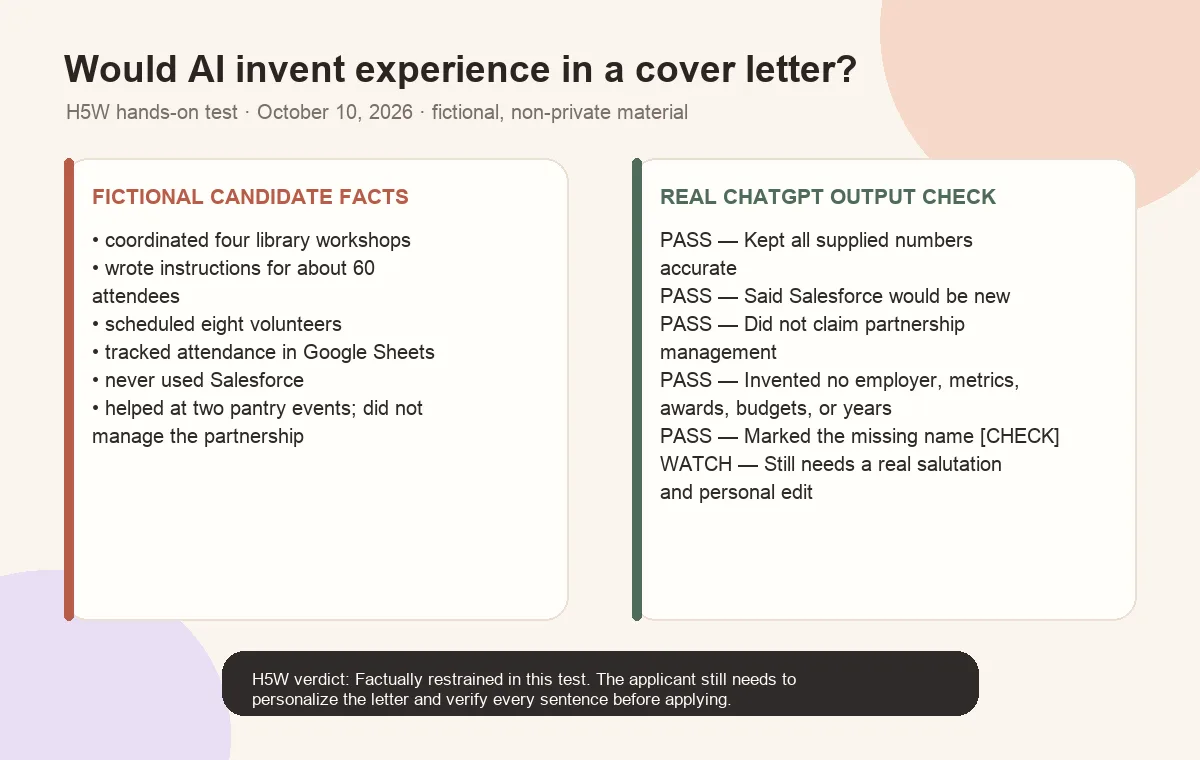
We would not submit that output unchanged. The salutation still needs a real name or a deliberate neutral choice, and the applicant should replace any sentence that does not sound like them when read aloud.
Make the opening sound like you
AI often starts with a sentence such as, “I am excited to apply for the position at your esteemed company.” That is correct but says almost nothing.
Replace it with a plain reason you could say aloud:
- the work matches a problem you have solved;
- the role uses a skill you want to keep developing;
- the product, service, mission, or customers genuinely interest you;
- the schedule, location, or type of team fits what you are seeking.
Do not claim a long connection to a company you just discovered.
Check the middle paragraph against your facts
For every claim, ask:
- Where did this fact come from?
- Is the skill actually mine?
- Did I personally do this work?
- Is the number real and supportable?
- Does the example match the requirement, or did the AI stretch it?
Watch upgraded verbs. “Helped organize” should not become “led,” and “worked with customers” should not become “managed client accounts.”
If the job asks for experience you do not have, write about a related skill or your plan to learn it. Do not hide the gap with confident language.
Remove the generic AI phrases
Search for lines that could belong to anyone, such as “I am a perfect fit,” “I bring a unique blend of skills,” or “I thrive in fast-paced environments.”
Replace each one with a fact, delete it, or use simpler wording.
Read the letter aloud. If you would never say a sentence in an interview, rewrite it.
Keep the letter focused
Do not repeat every resume bullet. Answer three things: why this role, which real experience shows you can help, and what you would like to discuss next. Follow the employer's format and length instructions.
Protect your information
Career centers recommend removing personal information before sharing application materials with AI.
Use the guide to information you should never share with AI before pasting an application. Describe confidential work without revealing the project.
The final check before you apply
- The company and role are correct.
- Every experience, skill, and result is true.
- No
[CHECK]markers remain. - The letter answers the actual job requirements.
- The opening and closing sound like you.
- The tone matches the company without copying its marketing language.
- A trusted person has reviewed important applications when possible.
UC Davis advises using AI as a coach rather than submitting AI-generated application material without careful revision. That is the right boundary: let the tool help you think and edit, while the final letter remains your work.
The bottom line
Give AI fewer, better facts. A short truthful letter built from two specific examples is stronger than a polished page full of claims you cannot defend.
If your resume also needs work, start with How to Improve Your Resume With AI.
Sources and verification
Information last verified: October 10, 2026.
- UC Davis Career Center: Using AI in Your Materials
- UC Davis Career Center: Resume, CV, and Cover Letter Guide
- Oregon State University Career Development Center: Using AI for Resume and Cover Letter
- OpenAI: Data controls in ChatGPT
Hands-on test completed October 10, 2026, using a fictional, non-private job and candidate profile.
Free printable resource
AI Career Application Workbook
Use the practical version while you work. It is a selectable-text U.S. Letter PDF with no email gate.
Public H5W PDF with selectable text and permanent source links.
Keep going
Choose your next step
Return to Jobs for the full collection, or continue with a closely related guide.