

How to Turn Customer Reviews Into an Improvement List With AI
You have reviews from email, Google, a booking form, or a survey. You can see complaints and compliments, but it is hard to tell which themes repeat and which comments appeared only once.
Make the themes traceable: give every review an ID, ask AI to support each theme with those IDs and a count, keep one-off comments separate, and treat the result as a list to investigate—not proof of what all customers think.
Prepare the reviews
Put the feedback in a simple format:
R01: Booking was easy, but I never received a reminder email.
R02: The instructor explained everything clearly. The room was hard to find.
R03: Great class. Please offer an evening time.
The IDs make the output auditable. When the AI claims that three reviews mention directions, you can check exactly which three.
Remove names, email addresses, order numbers, phone numbers, payment information, health details, and private complaints about identifiable employees. Keep only the words needed for the analysis.
Copy this prompt
Analyze these customer reviews using only the text provided.
Do not infer customer demographics, overall satisfaction, causes, or business impact.
Group repeated issues and positive themes. For every theme, show:
– the review IDs that support it;
– the number of supporting reviews;
– one short representative quote;
– a practical next step labeled “Do now,” “Investigate,” or “Monitor.”
Keep one-off comments separate. Do not turn opinions into facts. Finish with five questions the business should answer before changing anything.
REVIEWS:
[paste the cleaned, numbered reviews]
Do not ask for percentages unless you know the sample is complete and meaningful. “Three of these 12 reviews mentioned directions” is safer than “25% of customers cannot find us.”
What happened in H5W's test
H5W tested the prompt in a logged-in ChatGPT Temporary Chat on October 11, 2026. We used 12 fictional workshop reviews containing repeated comments about room directions, reminder emails, handout readability, class times, instructor support, and booking ease.
The result correctly found:
- three reviews about finding the room or entrance;
- two about missing reminders;
- two about small handout text;
- two requesting alternative class times;
- three positive comments about the instructor;
- two positive comments about booking ease.
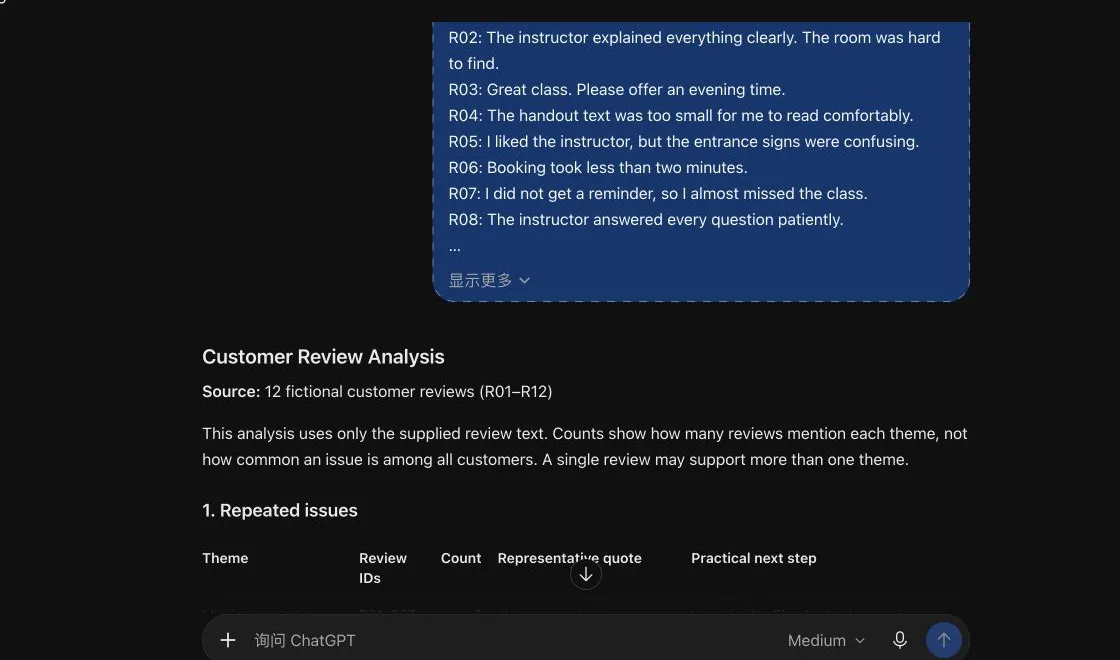
It tied every theme back to review IDs and warned that counts represented mentions in the small test set, not verified incidents or all customers.
One grouping still needed human judgment. The AI placed an evening-class request and a Saturday-class request under “alternative class times.” That is reasonable as a broad theme, but those are different scheduling requests. The output noticed the difference and said they should be assessed separately.
That is a good model for using AI here: let it organize the evidence, then decide whether the grouping is useful for the actual business decision.
Turn themes into sensible next steps
Use three levels:
- Do now: a low-risk check or fix supported by clear evidence, such as reviewing the font size on a named handout page.
- Investigate: check the process or records before changing anything, such as whether reminder messages were configured and delivered.
- Monitor: record additional examples before treating a one-off comment as a pattern.
The AI should not decide that a reported problem definitely caused lost sales, refunds, or churn unless you provide evidence for that claim.
Check these five things
1. Can every theme be traced back to reviews?
If the output cannot show the supporting IDs, remove the theme or ask it to try again.
2. Did one long review create several “customers”?
Counts should usually mean unique reviews, not sentences or mentions.
3. Were different requests combined too broadly?
Evening classes and Saturday classes are related, but they are not the same option.
4. Did AI turn an opinion into a fact?
“The room felt cold” is a customer's experience. It does not prove the temperature was outside an acceptable range.
5. Is the sample biased?
Online reviewers may not represent quiet customers, canceled bookings, people who never purchased, or all locations and time periods.
A useful follow-up prompt
After checking the themes, ask:
Create an improvement list with four columns: issue to check, evidence from these reviews, information still needed, and the smallest reversible next step. Do not estimate revenue impact or customer prevalence.
This keeps the output practical without making it sound more certain than the evidence allows.
When a spreadsheet is easier
For more than a few dozen reviews, use a CSV with columns such as review_id, date, source, location, and review_text. Keep the original file unchanged and ask for a separate theme table.
If the file needs cleanup first, use How to Clean Up a Spreadsheet With AI Without Breaking the Data.
Privacy and customer trust
Publicly visible reviews can still contain personal details. A private email or support ticket can contain much more. Remove identifying information and follow the rules for the platform, your business, and your customers.
Temporary Chat is not used to improve OpenAI's models while it remains temporary, but OpenAI says a copy may be kept for up to 30 days. A business-approved workspace may have different controls. Check before using real customer feedback.
Use How to Check Whether an AI Answer Is Correct when a proposed improvement depends on counts or factual claims.
The bottom line
AI can make a pile of reviews easier to scan. The most trustworthy output shows which reviews support each theme, keeps one-offs visible, and separates evidence from suggested action. Use it to decide what to investigate next, not to declare what every customer thinks.
Sources and verification
Information last verified: October 11, 2026.
- OpenAI: Data analysis with ChatGPT
- OpenAI: Uploading files and audio to ChatGPT
- OpenAI: Temporary Chat
- OpenAI: Data Controls
Hands-on test completed October 11, 2026, using 12 fictional workshop reviews with no real customer information.
Free printable resource
AI Business Writing Brief Pack
Use the practical version while you work. It is a selectable-text U.S. Letter PDF with no email gate.
Public H5W PDF with selectable text and permanent source links.
Keep going
Choose your next step
Return to Small Business for the full collection, or continue with a closely related guide.