
Are AI Detectors Accurate? What to Do If Your Writing Is Flagged
You wrote the paper, application, report, or article yourself. Then someone ran it through an AI detector and said part of it looks machine-written.
Do not keep rewriting your work just to chase a lower score. Save the flagged version, collect your drafts and sources, ask which detector and policy were used, and request a human review. An AI-detector score is a signal to investigate—not proof of who wrote the text.
What to do first
1. Save everything as it is
Make a copy of the document that was flagged. Keep the detector report or screenshot, the submission receipt, and the message you received.
Do not run the document through a “humanizer.” Do not replace sentences until they pass a detector. Those changes can make it harder to show how the original work developed.
2. Gather your writing trail
Useful evidence can include:
- Google Docs or Microsoft Word version history;
- outlines, handwritten notes, mind maps, or earlier drafts;
- research tabs, source PDFs, quotations, and citation notes;
- comments or feedback from a teacher, editor, coworker, or client;
- file creation dates and saved copies;
- an honest record of any AI, grammar, translation, or accessibility tool you used.
Version history is usually more useful than a second detector score because it shows the work changing over time.
3. Ask for the exact report and rule
Find out:
- which detector was used;
- whether the score covers the whole document or only “qualifying” prose;
- which passages were highlighted;
- what the relevant school, employer, client, or publisher policy says;
- whether grammar checking, translation, outlining, or other AI assistance was allowed;
- what review or appeal process is available.
A percentage without the report, text length, tool version, and policy context is easy to misread.
4. Ask a person to review the evidence
Keep the message calm and factual. State what you did, disclose permitted tool use truthfully, and offer the materials that show your process.
Copy this message
Hello [NAME],

I understand that [WORK] was flagged by [DETECTOR OR REPORT] on [DATE]. I wrote this work myself. [IF RELEVANT: I used [TOOL] only for [ALLOWED PURPOSE], in line with [POLICY].]

Could you please share the full report, including the highlighted passages, and explain how the result is being used under [POLICY]?

I can provide [EVIDENCE], such as version history, outlines, drafts, notes, and sources. I would appreciate a human review of that material before any decision is made.

Thank you,
[YOUR NAME]
Replace [NAME], [WORK], [DETECTOR OR REPORT], [DATE], [POLICY], [TOOL], [ALLOWED PURPOSE], [EVIDENCE], and [YOUR NAME]. Remove the optional AI-use sentence if it does not apply; never make a false claim about how the work was produced.
Are AI detectors accurate?
Some current detectors are better than the early tools, especially on longer English prose that resembles their test data. Their makers publish accuracy and false-positive claims, and the systems continue to change.
That still does not make a score proof.
Turnitin's current guide says its model can misidentify human-written, AI-generated, and AI-paraphrased text, and that the result should not be the sole basis for action against a student. It also hides numerical scores below 20% because that range has a higher incidence of false positives.
GPTZero says no detector is 100% accurate, performs best on longer English prose, and should be used to start a conversation rather than deliver a final verdict. OpenAI withdrew its own public text classifier in 2023 because of its low accuracy. That older tool is not a measure of every detector available today, but it is a useful reminder that the field changes quickly.
Accuracy depends on more than the brand name:
- the length and type of writing;
- the language and the writer's style;
- which AI model, paraphraser, or editing tool may have been used;
- how much human editing took place;
- the detector version and threshold;
- whether the text resembles the data used for testing.
A false positive means human writing is labeled as AI. A false negative means AI writing is labeled as human. Both can happen.
What H5W's small test showed
H5W checked two known-origin samples with Grammarly's public AI detector on October 23, 2026. No account was used.
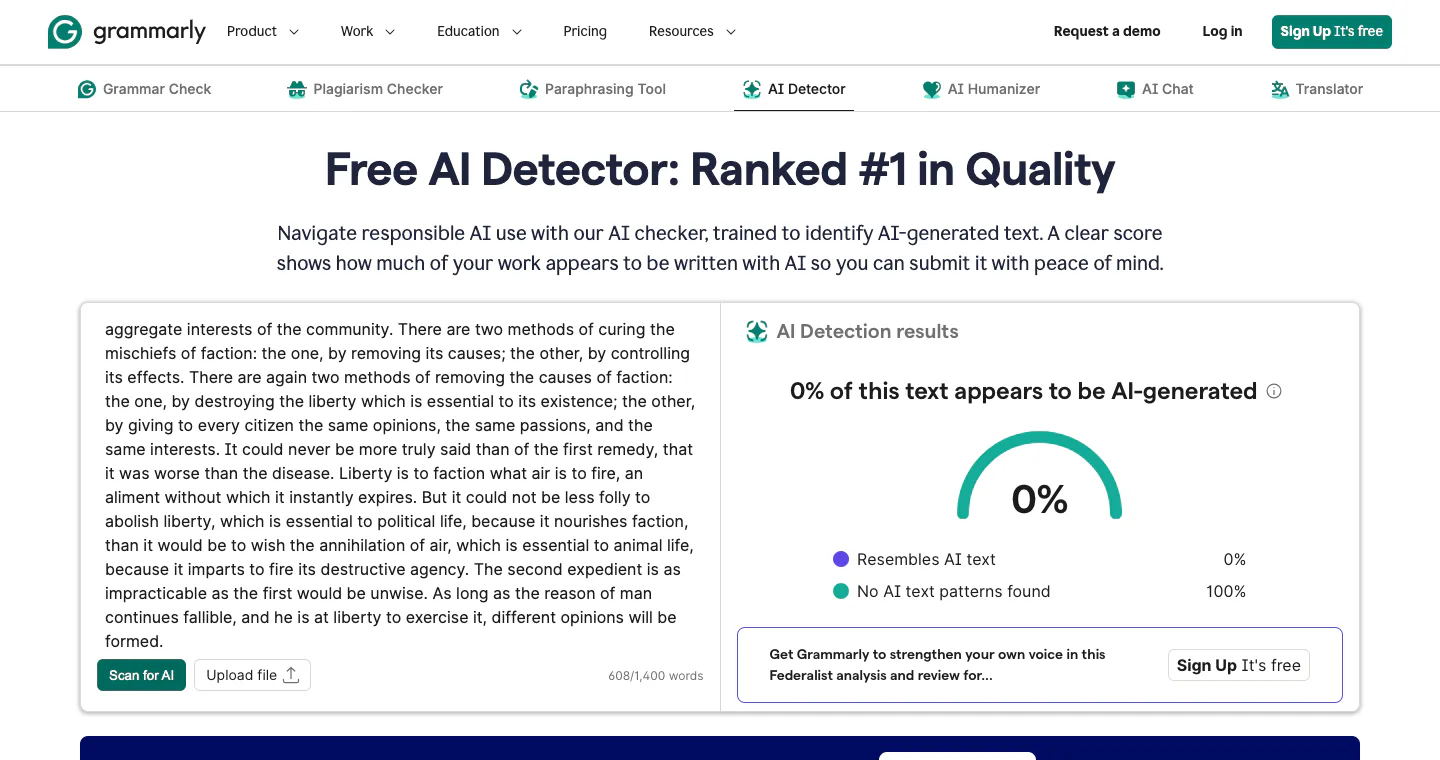
First, we pasted 608 words from Federalist No. 10, published in 1787—long before generative AI. Grammarly reported that 0% of the text appeared to be AI-generated.
Then we tested a 477-word AI-generated passage about community gardens created for this article. Grammarly reported that 100% appeared to be AI-generated.
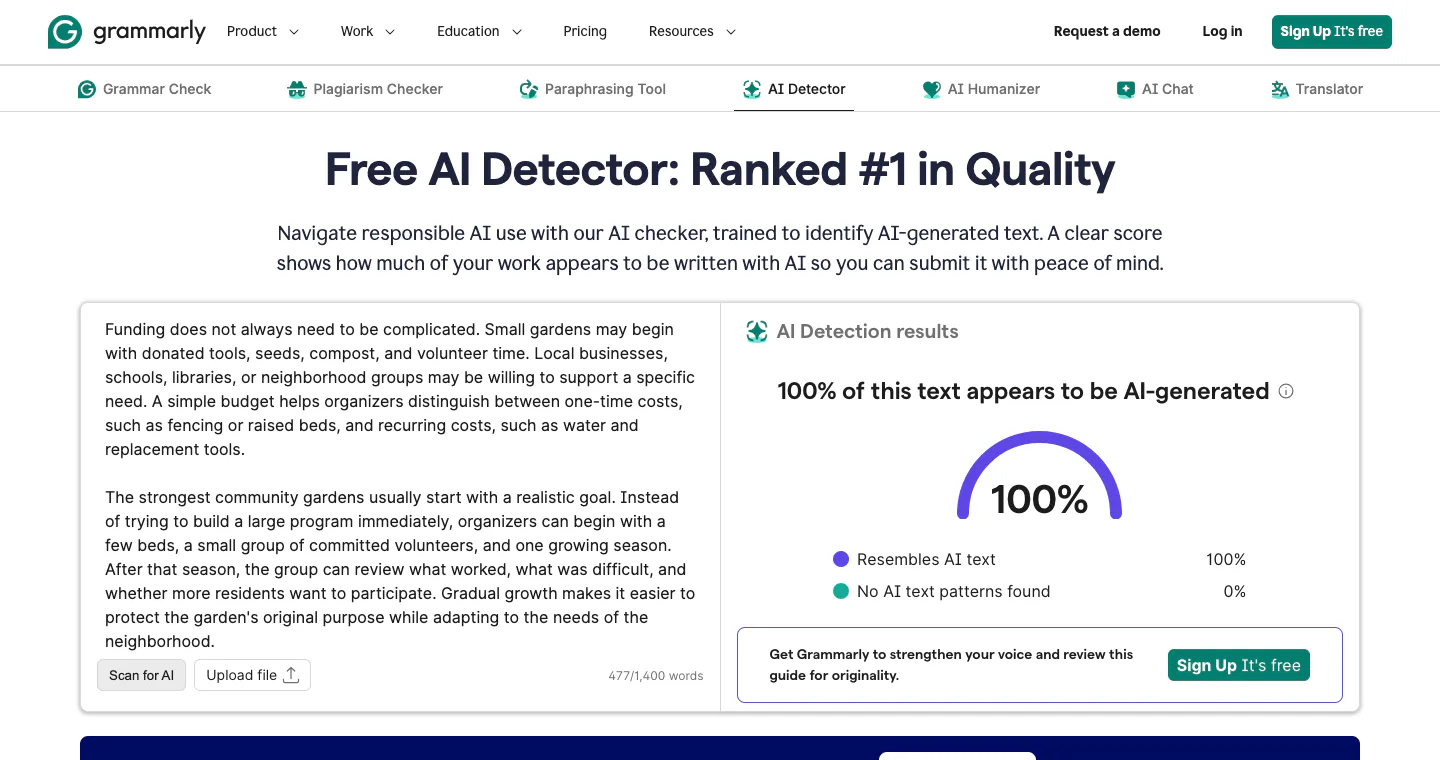
The detector got both of these samples right. That does not establish an overall accuracy rate. Two long, single-author English passages are much easier than short answers, mixed human-and-AI drafts, translated writing, heavily edited text, or writing from an unfamiliar style. The test shows that a detector can provide a useful clue; it does not show that every flag is correct.
Who is more vulnerable to a false flag?
A 2023 peer-reviewed study tested seven detectors available at the time and found that essays written by non-native English speakers were much more likely to be misclassified than a comparison set of U.S. eighth-grade essays. That study did not test every current detector, and detector companies say newer models have improved. It still shows why a person should examine the writing process and context instead of treating one score as a verdict.
Short, highly structured, formulaic, translated, or heavily edited text can also be difficult to classify. A company bio, lab method, policy paragraph, or résumé bullet may sound predictable because the format leaves little room for personal style.
Should you check your own work with several detectors?
Usually, no.
Different tools can return different answers, and uploading an unpublished paper or workplace document may create a privacy or confidentiality problem. A clean score from another site does not cancel the first score, and a second flag does not prove misconduct.
If your institution provides an approved preview tool, read its privacy rules and use it only as directed. Otherwise, spend that time saving the writing trail and checking the policy.
Never upload confidential work, client material, student records, unpublished research, personal information, or someone else's document to a random detector.
If the review still feels unfair
- Follow the written appeal or academic-integrity process, not an argument in a hallway or comment thread.
- Ask for the evidence, decision-maker, deadline, and next step in writing.
- Bring version history and source notes rather than a stack of competing detector screenshots.
- If you used an allowed tool, describe exactly what it did. “I used grammar suggestions on these sentences” is more useful than “I used AI a little.”
- If the stakes are serious, speak with the appropriate student adviser, union representative, HR contact, editor, or other responsible support person.
This guide is practical information, not legal advice. Rules and appeal rights differ by school, employer, publisher, contract, and location.
The part that matters most
You do not need to prove that every AI detector is bad. You need a fair review of your work.
Preserve the document, show how it developed, ask for the exact report and policy, and keep the discussion centered on evidence rather than one percentage.
If AI helped with research or factual claims, use How to Check Whether an AI Answer Is Correct before you submit. Before uploading any draft to an outside service, review What Information Should You Never Share With AI?.
Sources and verification
Information last verified: October 23, 2026.
- Turnitin: Using the AI Writing Report
- GPTZero: AI Detection Technology and Limitations
- OpenAI: New AI Classifier for Indicating AI-Written Text
- Liang et al., Patterns: GPT Detectors Are Biased Against Non-Native English Writers
- Vanderbilt University: Academic Integrity and Generative AI
- Grammarly: Free AI Detector
Keep going
Choose your next step
Return to Safety & Privacy for the full collection, or continue with a closely related guide.